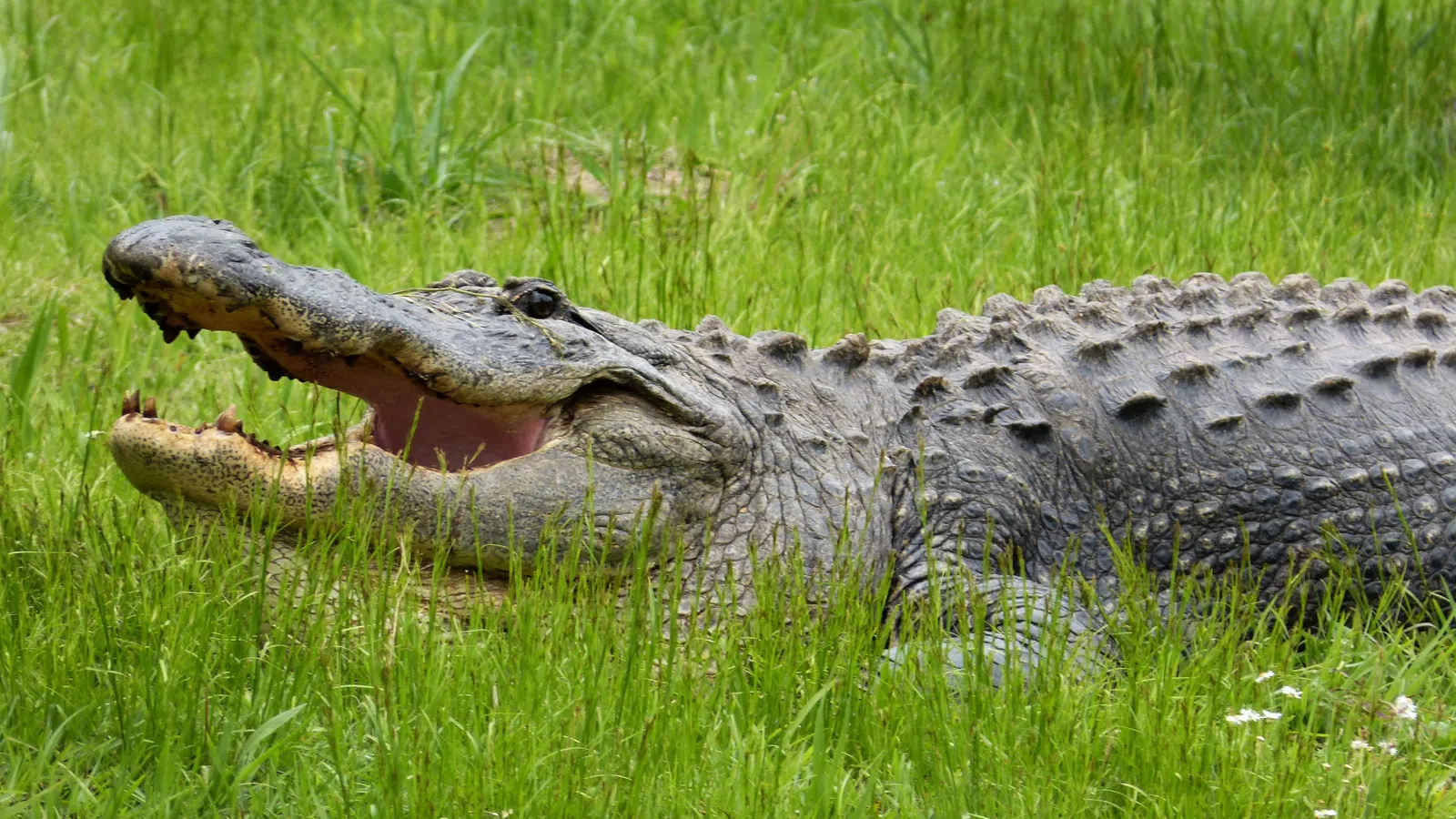
The American Alligator
Although the American alligator (alligator mississippiensis) can be found throughout the southeastern United States, it is a state symbol of Louisiana—and frightening to encounter up close.
Wild alligators can grow between 8 to 15 feet in length, weighing hundreds and even over 1,000 pounds. They have a lifespan of about 70 years. Those in captivity can live even longer. As an apex predator, these living tanks seem almost unstoppable.
Humans realized the value of the animal's rugged hide for leather in the 1800s and nearly decimated the state's population by the 1950s. Alligator season was closed from 1962 to 1972, and the creature was listed as an endangered species in 1967. The United States Fish & Wildlife Service and the Louisiana Department of Wildlife & Fisheries (LDWF) worked to understand alligators better to help increase the wild population.
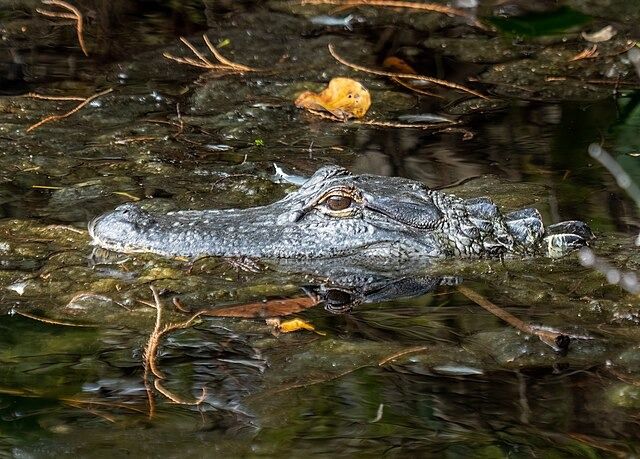
The LDWF explained their alligator management effort, "Since more than 80% of the coastal wetland habitat in Louisiana is privately owned, LDWF developed a controlled wild harvest program to provide an economic incentive for landowners to maintain or enhance important wetland habitat and protect alligators. The goals of LDWF's alligator management program are to manage and conserve Louisiana's alligators as part of the state's wetland ecosystem and provide benefits to the species, its habitat, and the other species of fish and wildlife associated with alligators. First implemented in 1972 on an experimental basis in Cameron Parish, this program expanded from the southwestern parishes to the entire state by 1981."The American alligator was officially removed from the endangered species list in 1987. Nearly 3,000 licensed alligator hunters haul in tens of thousands of gators annually.
Predators who feast on young gators and other environmental happenings take out up to 85% of hatchlings. Seeing a need for sustaining the entire population, a program was created in 1986 to farm gators. The LDWF stated, "Licensed alligator farmers are allowed to collect alligator eggs on private lands and incubate and hatch those eggs under ideal growing conditions, including adequate food supply and proper air and water temperatures. They then transfer those hatchlings to secure facilities and raise them until they reach approximately three to five feet in length. To ensure a stable, growing wild population, alligator farmers are required to return approximately 10% (depending on size) of their three- to five-foot alligators to the wild. This size alligator has a better chance of survival in the wild than a hatchling, and farm-raised alligators are consistently produced every year (in the wild, successful reproduction is subject to factors such as predators, flooding, etc.)." Alligator ranchers harvested almost half a million gators in 2019.
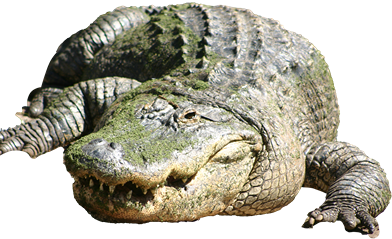
Insta-Gator Ranch & Hatchery in Covington opened in 1989 to take part in the conservation program, and it opened to the public as an entertainment and educational experience in 2001. Insta-Gator Ranch boasts being the home of about 2,000 alligators at any given time. Those who dare enter will get up close to the creatures, both big and small. The guided tours begin with education about alligators and how they fit into the local ecosystem. From there, you'll encounter hundreds of alligators. The youths can be held and fed, but the big guys can be safely seen from protected pathways above their ponds. During the hatchling season, visitors can watch as baby gators first tear through their soft shells with a bony protrusion on their snout, called an egg tooth, that eventually falls off.
The Audubon Nature Institute has gators at both the Audubon Aquarium and Audubon Zoo. Some of them are average dark green gators, and others look like they could be ghosts. Lurking quietly in Audubon Aquarium's Down on the Bayou exhibit is the most popular, rare beauty and beast.
Tchompitoulas is a leucistic alligator, meaning he has a white hide and stunning blue eyes. It's now known how many alligators are leucistic, but there are just a few known cases. The entire marshy exhibit places you underneath the water looking up at the fish and birds of prey. You can get within inches of 16-year-old Tchompitoulas to gaze upon his magnificence or watch him feed. Tchompitoulas is happy to spend his time inside because his white hide makes him susceptible to sunburns unlike his friends at Audubon Zoo with dark green skin. They need to bask in the sun to regulate their body temperature.
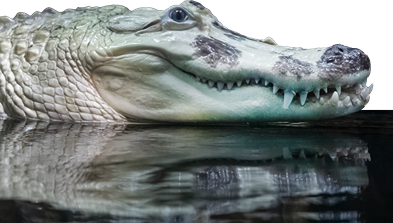
Another of Audubon's leucistic alligators, named Victor, underwent a successful cataract surgery thanks to LSU Veterinary Teaching Hospital in 2025. He was found by the Louisiana Department of Wildlife & Fisheries and given to Audubon Nature Institute in 2019 after six years.
Many of the leucistic gators in captivity today are found in southern Louisiana. In 1987, fishermen in Houma came across a nest on the Louisiana Land & Exploration Co.'s land that contained several gorgeous white hatchlings. They took some of them to give to Audubon Zoo and to a friend in another state. After the discovery, employees of Louisiana Land & Exploration trapped the remaining hatchlings. There were 19 leucistic gators total. Over the years, some of the rare gators have passed away, while the others live out their days at zoos around the country.
These captive gators can be admired closely behind glass, but it's fun to spot wild gators from the safety of a boat. Honey Island Swamp Tours and Cajun Encounter Tours are happy to bring you right up the gators in the beautiful swamps of our state. Our flagship monsters would love to "meat" you.