Come for COOLinary, Stay for the Culture
When my guest and I ducked into Desire Oyster Bar on a stormy August evening, Bourbon Street was considerably quieter than usual. It wasn't surprising. Between the downpour outside and New Orleans' notoriously sluggish late-summer tourism season, this is exactly the kind of night COOLinary New Orleans was created to enliven.
Inside the Royal Sonesta New Orleans, we settled into a nearly empty dining room and began working our way through Desire's three-course COOLinary menu. Three and a half hours later, the scene had completely changed. Tables were packed with large parties and birthday celebrations, and at one point, seemingly the entire restaurant joined in singing "Happy Birthday." What began as a quiet dinner had become a loud, celebratory, unmistakably New Orleans evening—and somewhere between the boudin eggrolls and bread pudding, we'd discovered that the food was only part of what makes Desire special.
We were already excited to see another side of the Royal Sonesta. Just a few weeks earlier, I had visited Restaurant R'evolution, also inside the hotel, for its Pearls & Pour celebration. This time, we were headed to the considerably more casual Desire, the Bourbon and Bienville corner restaurant serving Louisiana cooking for breakfast, lunch and dinner.
COOLinary gave us the perfect excuse. The annual August promotion encourages locals and visitors to venture into restaurants during one of the city's slowest months with specially priced prix-fixe menus. Desire's $58 three-course dinner offers two first-course choices, three entrée options and a decision between two decadent desserts.
We did what any two people faced with seven options and a professional obligation to investigate would do: tried everything.
The crab and corn bisque was comfort in a bowl, warm and creamy without crossing the line into heaviness. Its texture was smooth and satisfying, with generous pieces of crabmeat appearing throughout. It was the kind of soup that would have been welcome under any circumstances, but with rain coming down outside, it felt particularly well timed.
Then came the boudin eggrolls, accompanied by pepper jelly. The crisp wrappers gave way to warmly spiced boudin with enough kick to make itself known without overwhelming the other flavors. The sweetness of the pepper jelly tempered that spice beautifully. Whatever formality we'd brought to the table disappeared quickly: we abandoned our utensils, picked up the eggrolls with our hands and devoured them.
That moment says quite a bit about Desire.
There is an unusual line the restaurant manages to walk. The cooking and plating can feel worthy of a fine-dining restaurant, but the room never demands fine-dining behavior. Guests came through the doors in everything from Bourbon Street beads and jeans to dressier ensembles. Our cocktails arrived adorned with tiny flowers, and more delicate floral garnishes appeared across several of our beautifully composed plates, yet nobody blinked when we ate an eggroll with our fingers or spent half the evening chatting with employees as though we'd known them for years.
Then there was the salad.
Of everything we ate, the fried-oyster wedge may have been the biggest surprise. Perhaps that's because "wedge salad" doesn't normally inspire the same anticipation as barbecue shrimp or bread pudding—or because Bourbon Street isn't necessarily where I'd send someone searching for one of the best salads they've ever eaten.
I may have to start.
Chef de Cuisine Dwayne Butler's take piles fried oysters, grilled corn, cherry tomatoes, bacon, hard-boiled quail eggs, blue cheese dressing and crumbles around an iceberg wedge. It sounds like a lot, but somehow, it wasn't. Instead, the cool crunch of the lettuce, crisp coating of the oysters, smoky-sweet corn, salty bacon, creamy blue cheese and tiny quail eggs worked together in a succession of contrasting textures, and made me completely forget that I've been scared to eat lettuce for weeks because of the recent recalls.
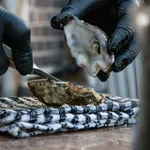
This was not a perfunctory salad thrown onto a menu because someone needed a lighter option. It felt luxurious, the kind of salad I would expect to encounter in a much more formal dining room. I packed up what I couldn't finish and, hours later, opened the container at home and ate the rest at midnight. It was still that good. For someone wanting a lighter French Quarter lunch, I'd happily order the wedge by itself—although adding a gumbo they are so proud of or a few of Desire's chargrilled oysters would make a convincing argument for lingering. We got to sample those as well when Butler sent out two different preparations of chargrilled oysters, one of Desire's specialties. They were noticeably spicier than many of the chargrilled oysters I've eaten around New Orleans, with considerably more heat behind the familiar richness, and we loved them.
The barbecue shrimp and grits demonstrated another side of Butler's cooking. Rather than simply reproducing the familiar New Orleans preparation, Butler builds his version around a shrimp reduction, using stock, heads and shells along with wine, spices and a few ingredients he wasn't willing to divulge. The result is a velvety Creole sauce with a subtle sweetness and a wine flavor that settled beautifully into the creamy grits beneath it.
It also made perfect sense once Butler told us how his career began. A New Orleans native raised in Tremé by way of the Sixth Ward, Butler has worked in kitchens for more than three decades. Early in his career, he trained as a saucier, learning the foundations of soups, stocks and sauces. He spent time around chefs he considers among the city's greats, including Alex Patout, and describes himself as a "cultural bearer" whose cooking remains connected to the traditional food, jazz and culture he grew up around. You can taste that training in the barbecue shrimp.
I'd recently had the unusual opportunity to sit with Emeril Lagasse while he prepared his own barbecue shrimp, so the classic version was still fresh in my memory. Butler's isn't trying to replace that tradition. What impressed me was how clearly his own culinary background came through in a completely different interpretation built around a sauce that tasted as though someone had spent a career learning exactly how to coax flavor from a stockpot.
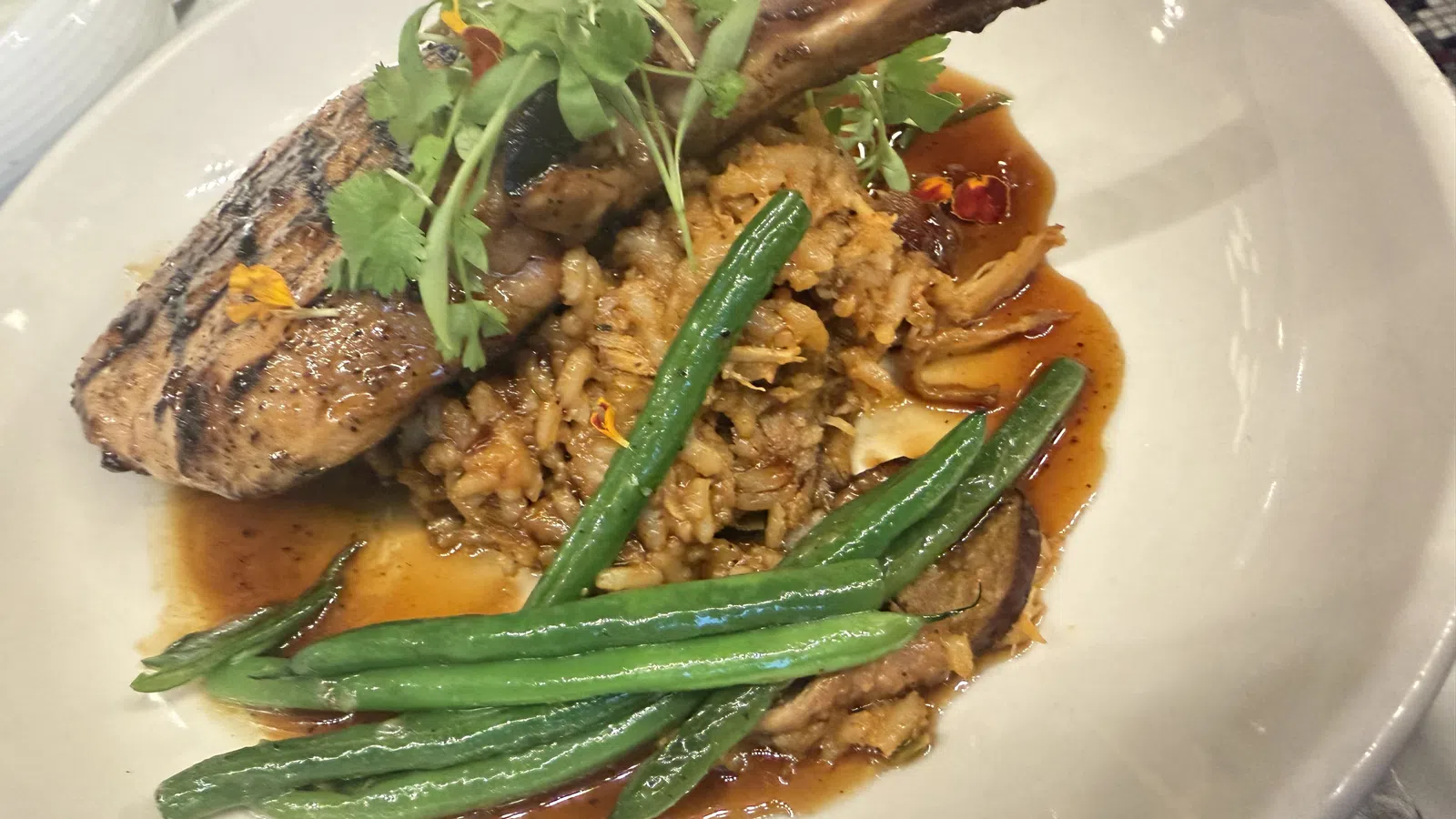
The bourbon-glazed pork chop offered still another interpretation of Louisiana comfort food, served with Creole jambalaya and sautéed green beans. Butler described the dish to us as having the substance and masculinity of a pork chop with "a little femininity" in its presentation. It was an unexpectedly perfect description of his plating throughout the evening. There was nothing precious about the portions, but there was obvious care in how each plate reached the table with the aforementioned flowers and delicate garnishes softening dishes that remained hearty and unmistakably Louisianian.
Dessert maintained that standard. The Berryland cheesecake paired vanilla cheesecake with raspberry jam, blueberry compote and whipped cream, arriving as another meticulously composed plate. The bread pudding was even harder to stop eating. Tender without becoming soggy or dense, draped in whiskey caramel sauce and finished with just enough powdered sugar, it was among the better versions of a dessert I've eaten countless times in New Orleans.
But by that point, we'd realized Butler was as interested in talking about the people serving the meal as the food itself. He recently celebrated five years at Desire, but his hospitality career stretches back more than 30 years. It has supported his family, allowed him to raise his children and, he says, given him a career he would enthusiastically recommend to young people looking for their own path.
"I retain good people here, good people working under me," Butler said. "I try to treat them like they're humans," he said with a smile warm enough to make me consider changing professions. He welcomes young people coming out of culinary school, but his invitation extends beyond those with formal training. If someone wants a career in culinary arts, service or the hotel industry and is willing to learn, Butler is willing to train them. That sentiment could sound like the expected answer from a chef talking about his staff—until you spend time with them.
Austin Paul, one of the Royal Sonesta's food and beverage managers, recently marked his first year at the hotel. He helps oversee Desire as well as Le Booze, The Jazz Playhouse and the Oasis Pool Bar. Yet one of the things that impressed him most as a relative newcomer was how many of his colleagues had been there for decades.
"There's not many places you can go into and say that you have even more than three staff members there 20-plus years," Paul said, noting that after all that time they still "have each other's backs like a true family."
We met some of those longtime members of the Desire family over the course of the evening, including Doyle and Minouche who came out of the kitchen especially to greet us. Watching Butler interact with the people around him made his earlier comments about retaining good employees feel considerably less like a talking point. There was obvious affection between them—and just as much pride among the employees in the restaurant they had helped make their own.
We saw that dynamic play out throughout dinner. Employees joked with one another, stopped at our table and genuinely appeared happy to be there. By the end of the evening, getting everyone together for a group photo felt less like assembling restaurant employees for a publicity shot than interrupting a family gathering long enough to make everybody look at the camera.
That hospitality extended to our server, Pete Sulony, who somehow managed to be attentive without ever hovering. Courses appeared almost as soon as we were ready for them; he knew the menu well enough to guide us through it, remembered our names throughout the evening and anticipated what we needed before we had to ask. At the end of a meal that had produced a formidable collection of leftovers, he boxed everything, separated our food into individual bags and remembered exactly which dishes belonged to each of us. It was the kind of seemingly effortless service that is anything but.
Bartender Kiki Kiefer provided another glimpse into that hospitality. Her French 75 uses Courvoisier rather than gin, a variation I hadn't expected to prefer but did. When we asked what else she recommends to visitors, her list read like a crash course in New Orleans drinking: not only the French 75, but also a wonderful Sazerac and Hurricane among many other local favorites and classics. She also has some newer concoctions, and she sold us on lavender lemon drops that were delicious until the very last drops.
Her Hurricane is especially designed to push back against the drink's reputation as an overly sweet, brightly colored Bourbon Street cliché. Kiefer described Desire's version as combining rum with passion fruit, pineapple, orange and lime juices, a small amount of grenadine and a dark-rum float, with a splash of soda helping cut the sweetness.
"We're grown-ups, right?" she joked.
The result is still unabashedly tropical, but tastes like a cocktail rather than liquid candy. Although Kiki is a magnificent bartender, her true gift is that by the end of the night she makes you feel like she's a sister. We became instant friends, and sharing our life stories with each other was just another magical part of this experience. She got us some really cool photos, too, and it's obvious that she's learned how to give each guest the exact experience they're looking for, along with the rest of the Desire staff.
Paul, meanwhile, had already devised an entire Royal Sonesta itinerary when I asked how he'd spend a day at the property. He'd begin with a vanilla Velvet Ice from PJ's Coffee, eat at Desire—he praised everything from the breakfast omelet to its po-boys—and make sure his hypothetical visit fell on a Saturday so he could see The Nayo Jones Experience at The Jazz Playhouse.
That prompted Butler to distill the experience into three things: good food, good drinks and good music. "What is New Orleans?" he asked. "If you get a taste of all of these things together, now you've been to New Orleans—and you've been to Bourbon Street on top of that." He's right.
Visitors frequently ask me where they should go for "Cajun and Creole food" in New Orleans, a question that first requires the obligatory explanation that the two cuisines aren't interchangeable—and that some of Louisiana's best Cajun cooking requires traveling west toward Acadiana. Creole is another story, and Desire has earned a place on my recommendation list.
What makes it particularly useful is the very balance we experienced that evening. This is somewhere you can encounter food informed by a chef's decades of New Orleans culinary experience without committing to the ritual or price point of formal fine dining. You can order a carefully plated pork chop or an unexpectedly exceptional fried-oyster wedge, drink a properly made New Orleans cocktail, then pick up your boudin eggroll with your fingers. Nobody cares what you're wearing. You can be loud. The joy is contagious.
By the time we finished dessert, the restaurant we'd entered three hours earlier barely existed. More surprising was realizing that more than three hours had passed at all. My guest and I had been eating, talking and laughing with the people around us, and the evening had taken on the easy rhythm of spending time with friends rather than covering an assignment.
The stormy August quiet had given way to full tables and celebrations. Staff members we'd met throughout dinner gathered for photographs. Someone had a birthday, and voices from around the restaurant joined together to sing.
COOLinary had given us a reason to walk through Desire's doors. That, after all, is precisely what the August tradition is designed to do.
But Desire gave us something better than a dining deal: a reminder that excellent New Orleans food doesn't have to come with formality. Sometimes it comes with quail eggs and flowers. Sometimes you eat it with your hands. And sometimes the people serving it make you comfortable enough that three and a half hours pass before you realize you should probably go home.
Desire Oyster Bar's three-course COOLinary dinner is $58 and is available daily through August 31. Desire Oyster Bar is located inside The Royal Sonesta New Orleans at 300 Bourbon St. For menus, hours and additional information, visit the Desire Oyster Bar website: sonesta.com/royal-sonesta/la/new-orleans/royal-sonesta-new-orleans/desire-oyster-bar.